
Written by the Appliance Repair Rescue team. 11+ years of experience. Last updated: November 2, 2026.
You turn the knob. The stove clicks, and clicks, and clicks. But no flame appears. Dinner is waiting, and now you are standing in your kitchen listening to a noise that sounds like a broken clock.
This is one of the most common gas stove problems. It also has a simple explanation: your stove is making a spark, but the spark and the gas are not meeting the way they should. Sometimes the fix is as easy as setting a burner cap back in place. Other times, a part inside the range has failed and needs a trained technician.
This guide explains what each clicking pattern means, how to check the causes safely, and when to stop and call a professional for gas range and stove repair in Dallas. Safety comes first, so we start there.
Why Is My Gas Stove Clicking but Not Lighting?
A gas stove clicks but does not light when the igniter makes a spark but the burner does not catch fire. The most common causes are a burner cap that is not seated flat, clogged burner ports, or a wet igniter after a spill or cleaning. Less often, a worn igniter, a bad igniter switch, a failed spark module, or a power or gas supply problem is to blame.
Key Takeaways
- If you smell gas, leave the house first and call for help from outside. Do not troubleshoot.
- Most clicking-but-not-lighting problems come from three things: the cap, the ports, or moisture.
- Clean and dry the burner parts before you assume something is broken.
- If one burner is silent and the others work, the problem is local to that burner.
- If every burner is silent, check the power first. After that, the spark module is a common suspect.
- Igniters, switches, and spark modules involve high-voltage wiring near gas. These repairs belong to a technician.
Smell Gas? Stop and Do This First
If you smell gas at any point, stop. Do not keep trying to light the burner, and do not look for the source.
What to do right now:
- Turn every knob to off.
- Do not touch light switches, appliances, or plugs. A tiny spark can ignite gas.
- Leave the house and take everyone with you.
- From a safe distance, call 911 and your gas utility’s emergency line.
- Stay out until the utility or the fire department says it is safe.
In much of the Dallas area, the gas utility is Atmos Energy. Its 24-hour emergency number is (972) 370-8353. Atmos asks people to call 911 and Atmos from a safe distance, and it sends a trained technician to investigate at no cost. If your gas bill shows a different utility, call the emergency number printed on that bill.
Natural gas has no smell on its own. Utilities add an odorant that smells like rotten eggs so that leaks are easy to notice. Atmos also warns that you should not rely on smell alone. Colds, allergies, and other strong odors can hide it. If you hear a hissing sound near the stove or see signs of a leak, treat it the same way: leave and call.
A clicking sound by itself is not a gas leak. The danger signal is the smell, not the click.
Why Does a Gas Stove Click?
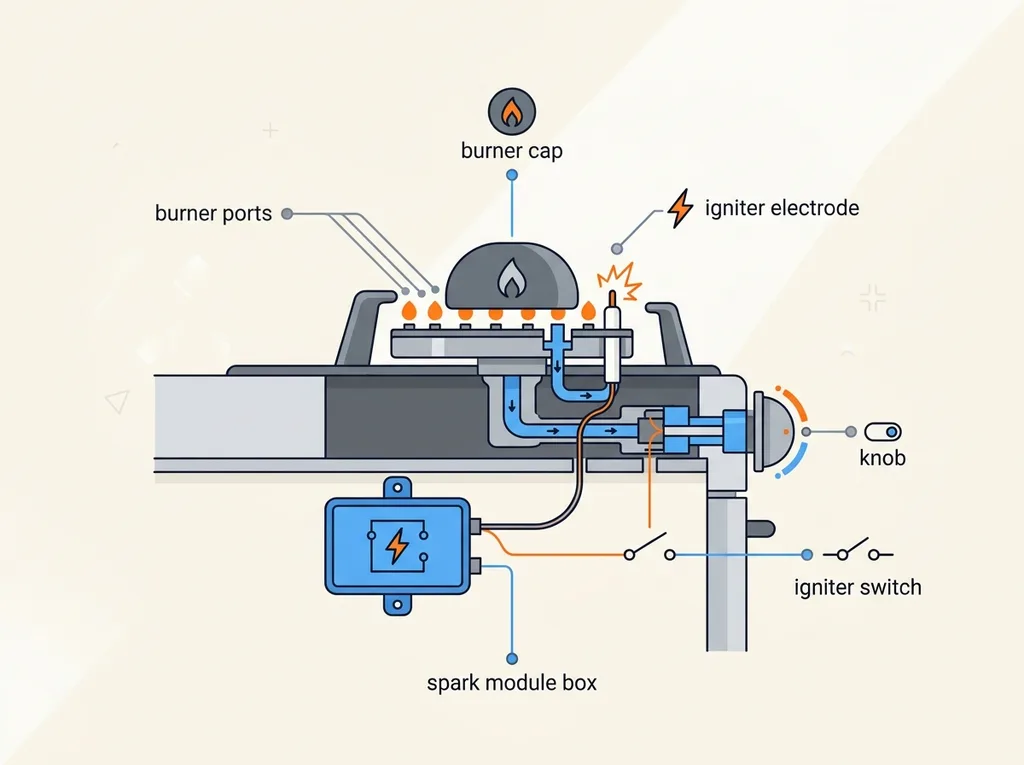
A gas stove clicks because an electronic igniter is trying to light the gas. When you turn a knob to the “Lite” position, two things happen at the same time. The valve lets gas flow to the burner, and a spark module sends a high-voltage spark to an igniter next to the burner. The spark lights the gas as it flows out through small holes called burner ports.
On many ranges, one spark module controls all of the burners. That is why you may hear every burner click when you turn just one knob. Some models also need several clicks before a burner catches. A few clicks are normal. Continuous clicking with no flame is not.
Here is a quick guide to the parts involved:
| Part | What it does | Why it matters |
|---|---|---|
| Igniter (electrode) | Makes the spark next to the burner | A wet, dirty, or cracked one can stop the flame |
| Burner cap | Sits on top and spreads the gas | If it is tilted, gas and spark do not meet |
| Burner ports | Small holes where gas comes out | Food and grease can block them |
| Igniter switch | Sits behind the knob and starts the spark | A bad one can cause silence or nonstop clicking |
| Spark module | Creates the high-voltage spark for the igniters | If it fails, all burners can go silent |
A quick note about older stoves. Some older gas stoves use a pilot light instead of a click igniter. They do not click. This guide covers modern stoves with electronic ignition.
Find Your Pattern in 30 Seconds
The way your stove clicks tells you where to look. Use this table to find your pattern.
| What you notice | Most likely cause | Start with |
|---|---|---|
| One burner clicks but no flame, others work | Cap, ports, or wet igniter on that burner | Cause 1, 2, or 3 |
| All burners click but none light | Moisture, gas supply, or a lockout feature | Cause 3, 5, or 7 |
| One burner makes no click, others do | Igniter or switch for that burner | Cause 4 or 6 |
| No burner clicks at all | Power, lockout, or spark module | Cause 5 or 6 |
| Clicking continues after you turn it off | Moisture or a stuck switch | The clicking-when-off section |
| Burner lights but clicking keeps going | Moisture or a re-ignition sensing issue | The clicking-when-off section |
| Problem started right after cleaning | Water in the igniter or a cap set crooked | Cause 1 or 3 |
| Problem started after a power outage | Control lockout or a surge-hit module | The power outage section |
7 Causes of a Gas Stove Clicking but Not Lighting
1. The Burner Cap Is Not Seated Correctly
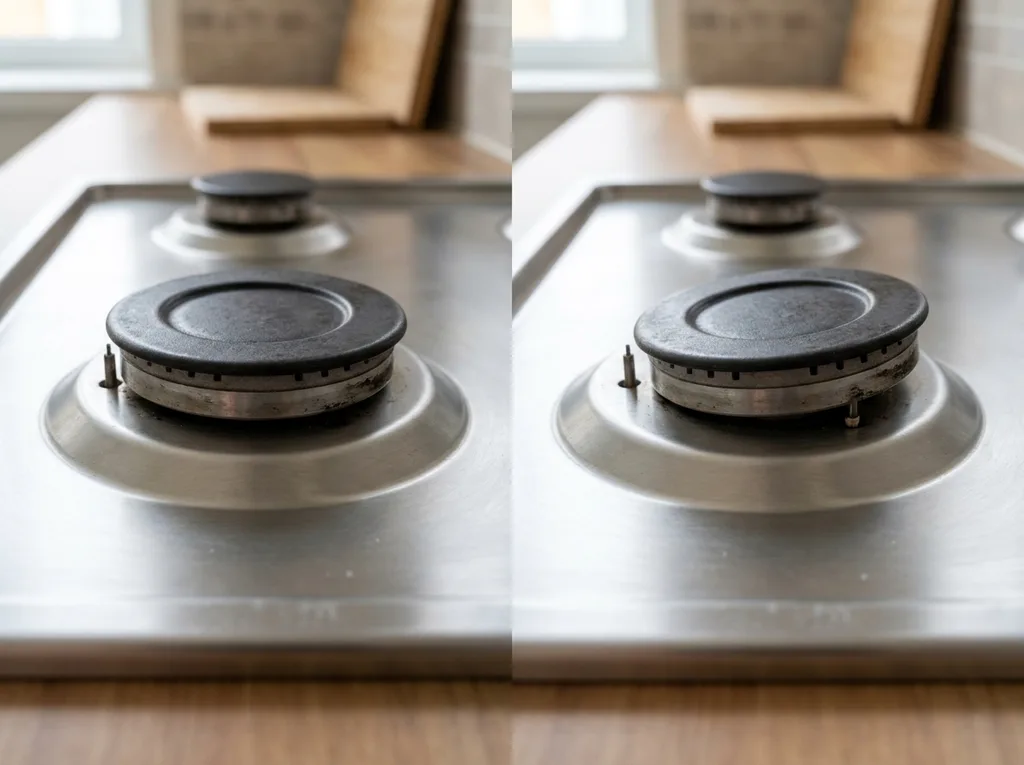
A burner cap that sits crooked can stop the flame, even when everything else is working. The cap spreads the gas evenly around the burner. If it is tilted, the gas goes in the wrong direction, and the spark cannot find it.
This is the number one cause after a cleaning or a boil-over, because it is easy to set the cap back slightly off center.
How to check and fix it:
- Turn all knobs off and let the stove cool.
- Lift off the grate and the burner cap.
- Look for crumbs or grease on the ring where the cap sits.
- Set the cap back flat and centered. Line up any notch on the cap with the tab on the base.
- Press gently on each side. It should not rock or wobble.
Burner caps are often not interchangeable. A cap from the large burner may not fit the small one. Make sure each cap goes back on its own burner. Sealed-burner designs, which are common on many Samsung, LG, and premium ranges, can be especially picky about cap position.
2. Clogged Burner Ports
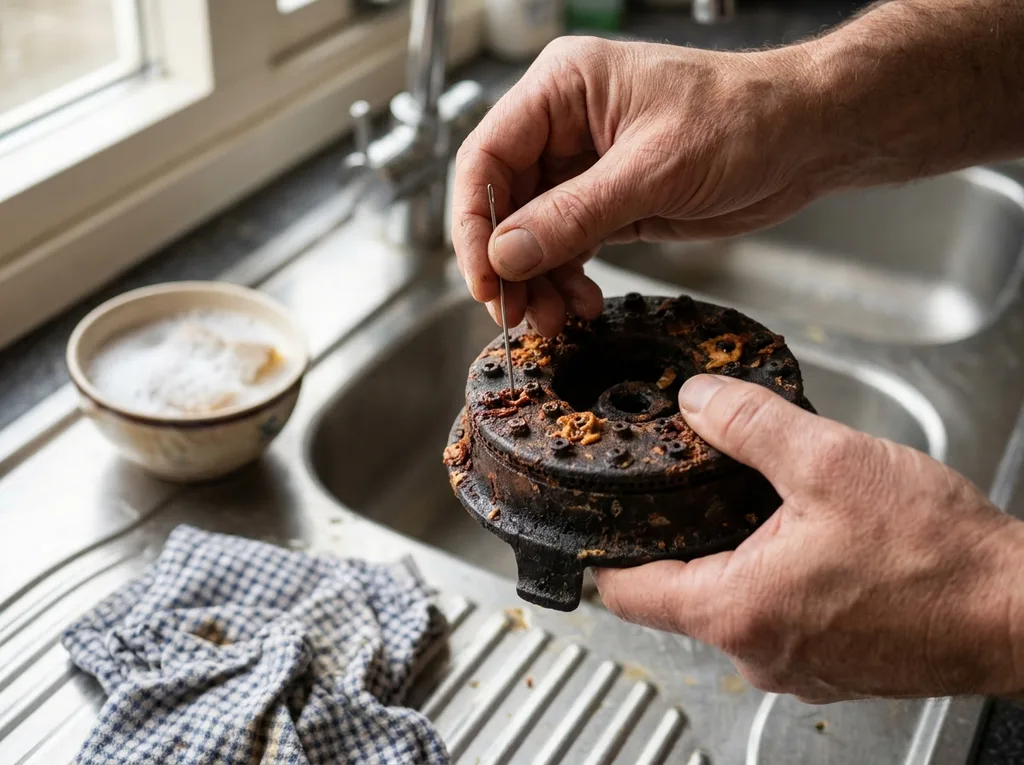
Blocked burner ports starve the spark of gas. Grease, sauce, and boil-overs can harden inside the tiny holes around the burner head. Gas then comes out unevenly or not at all in the spot next to the igniter.
How to clear them:
- Make sure the stove is off and cool.
- Remove the grate, cap, and burner head.
- Hold the head up to the light and look at each port.
- Clear each blocked port with a straight pin or a thin needle. Work gently, one port at a time.
- Wash the parts in warm, soapy water, rinse them, and let them dry completely.
- Put everything back and test.
Do not use a wooden toothpick. The tip can snap off inside the port and cause a new blockage. Also, do not make the holes bigger. Whirlpool’s own product help warns against enlarging or bending the ports. If a burner seems to need adjusting, that is a job for a trained technician.
3. A Wet Igniter or Wet Burner
Water on the igniter gives the spark an easier path than jumping to the burner, so you hear clicking but see no flame. This often happens after a spill, a boil-over, or a deep cleaning.
A helpful clue is timing. Moisture problems often come and go. The stove may fail in the morning or after you mop the kitchen, then work fine later in the day. A cracked igniter fails the same way every time, no matter the weather.
How to fix it:
- Remove the cap and burner head.
- Wipe the igniter and the area around it with a dry cloth. A dry cotton swab works well for small spots.
- Use a hair dryer on a cool setting for a minute or two. Do not use high heat, because it can damage the ceramic part of the igniter.
- Let the parts air dry. An hour or two is a good minimum for the burner parts.
- If the stove keeps clicking after that, leave it overnight and try again.
4. A Dirty, Weak, or Cracked Igniter
An igniter wears out over time. Heat, grease, and cleaning products slowly damage the small ceramic piece and its metal tip. A weak igniter can still click, but the spark may be too weak to light the gas.
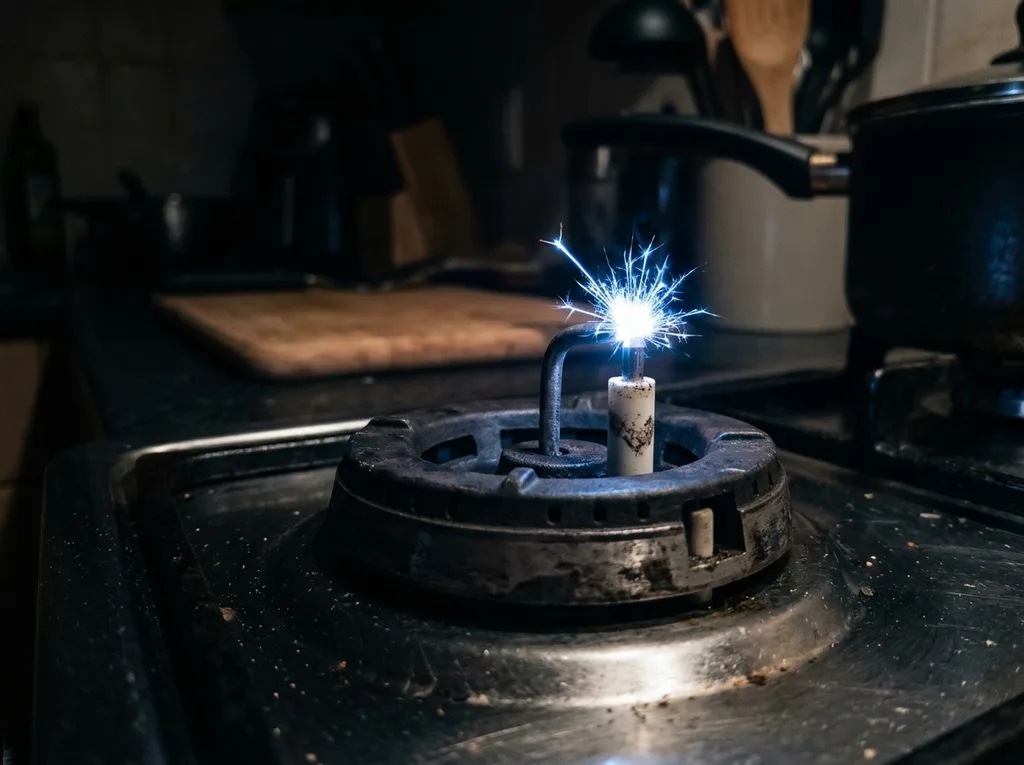
Try the spark test:
- Reassemble a clean, dry burner.
- Dim the kitchen lights.
- Turn the knob to Lite and watch the igniter tip for a second.
- Turn the knob off.
A strong spark looks blue-white and sharp. A weak spark looks yellow or orange, or you see no spark at the tip at all. A spark that jumps from the side of the ceramic points to a crack.
Before you touch the igniter, unplug the range or switch off its breaker. Wipe it gently with a dry cloth or a soft toothbrush. Do not spray cleaner on it, and do not scrub it hard.
If you see a crack in the ceramic, or the spark stays weak after cleaning, the igniter needs to be replaced. That job involves high-voltage wiring next to gas parts, so it is best left to a technician.
5. No Power: Breaker, Outage, or Control Lockout
Electronic ignition needs household power. A gas range with electronic ignition still needs to be plugged in to make a spark. If the range has no power, the gas may flow when you turn the knob, but there will be no click.
Check these things:
- The plug and the outlet. Make sure the range is plugged in firmly.
- The breaker. Look in your panel for a breaker that is tripped or sitting in the middle position. Switch it fully off, then back on.
- The display. Some ranges and cooktops have a control lockout feature. After a power loss, the burners may stay locked until the lockout is turned off. Whirlpool explains that on some models, you touch the lock key for about 3 seconds to turn it off. Check your owner’s manual for your model.
If every burner stays silent after these checks, move on to Cause 6.
6. A Bad Igniter Switch or Spark Module
The igniter switch and the spark module are two electrical parts that start the spark. When one fails, the click may stop, or it may never stop.
The pattern helps you tell which part is the problem:
- One burner is silent, and the others click. The igniter switch behind that knob, a loose wire, or that burner’s igniter is likely the problem.
- Every burner is silent, and the power is fine. The spark module is a common suspect, because it controls all the igniters.
- A burner keeps clicking after you turn it off, even when everything is dry. The igniter switch may be stuck closed.
These parts sit inside the range, behind the control panel or under the cooktop. They use high-voltage wiring. A technician tests them with the right tools before replacing anything, so you do not pay for a part you did not need. This is a good time to stop and call.
7. A Gas Supply, Flame Sensing, or Vent Problem
If the igniter sparks strongly and the burner still will not light, the gas may not be reaching the burner the right way.
Check these simple things:
- The gas shut-off valve behind or beside the range. It should be open. A bumped valve can cut the gas.
- Other gas appliances. If your water heater or dryer also has trouble, the issue may be bigger than the stove. Call your gas utility.
- A new range. The first time you use a new gas range, the lines may hold air. Whirlpool says to turn on a burner knob for a moment to release air from the gas lines. Do not do this if you smell gas.
- A downdraft vent. A strong downdraft fan can blow the flame away from the igniter. Whirlpool suggests lowering the fan speed or raising the burner flame setting.
If a burner lights and then goes out after a few seconds, a flame sensor or safety valve may be at fault. Do not try to adjust gas valves, regulators, or gas connections yourself. Those are jobs for a qualified gas technician.
Why Is My Gas Stove Clicking When Turned Off, or After It Lights?
Clicking that will not stop almost always comes from moisture, a crooked cap, or a stuck switch. A stove that clicks with the knobs off is not trying to light anything. Its ignition circuit is being told to keep sparking.
The three usual reasons:
- Moisture in the igniter switch. After a spill or cleaning, water can sit in the switch and hold its contacts closed. Dry the area around the knobs and the cooktop. Whirlpool suggests removing the knobs and blowing cool air from a hair dryer onto the knob shaft. Then leave the stove alone overnight.
- A burner cap touching the igniter. If the cap sits on the electrode tip or a crumb tilts it, the module may sense a steady arc and keep firing. Remove the cap, clear the seat, and set it back level.
- A stuck or shorted switch. If the clicking continues for about two days after everything is dry and the cap is correct, the switch is likely stuck on. It will not fix itself and needs to be replaced.
There is one more normal case. Some stoves with flame-sensing re-ignition keep sparking until they detect a flame. If a vent hood or draft pushes the flame away from the sensor, the clicking can continue even though the burner is lit. Raising the flame a little or slowing the downdraft fan can help.
A Safe 10-Minute Fix Order
Work through these steps in order. Stop as soon as the burner lights, or as soon as something does not feel right.
- Check for gas smell. If you smell gas, leave and call for help. Do not continue.
- Turn all knobs off and let the stove cool completely.
- Notice your pattern. One burner or all? Click or no click?
- Remove the grate and the cap. Look for food, grease, or damage.
- Clear the ports with a straight pin, one hole at a time.
- Dry everything. Wipe the igniter and use a cool hair dryer.
- Reseat the cap flat and centered.
- Test one burner. Turn the knob to Lite. If there is no flame within a few seconds, turn it off.
- Open a window and wait about 5 minutes (or as long as your owner’s manual says) before trying again. This lets any gas clear. Do not keep clicking over and over.
- Check power and the lockout. Look at the plug, the breaker, and any lock light.
- Stop and call a pro if the burner still will not light, if you see a cracked igniter, or if the clicking will not stop.
The cleaning steps usually take 10 to 15 minutes, plus drying time.
Lighting a Burner by Hand
Some owner’s manuals explain how to light a surface burner with a match or lighter during a power outage. If your manual allows it, you can use a long-neck lighter. Hold the flame at the burner first, then turn the knob to Lite.
Only do this if you do not smell gas, and only for a few seconds. If the burner does not light right away, turn the knob off and let any gas clear before trying again. If your stove lights by hand but not with the igniter, the ignition system needs service. Do not use hand lighting as a long-term fix.
What Not to Do
- Do not keep clicking and clicking. Every failed attempt can release unburned gas.
- Do not use a wooden toothpick to clear ports.
- Do not spray cleaner directly on the cooktop near the igniters. Spray it on a cloth first.
- Do not put burner parts back wet after washing them.
- Do not swap burner caps between different-sized burners.
- Do not touch the igniter or wiring with the stove plugged in.
- Do not adjust gas valves, regulators, or gas lines.
- Do not ignore a gas smell because the clicking seems minor.
What About a Gas Oven Igniter?
This guide is about the burners on top of your stove. A gas oven works differently. Many gas ovens use a hot-surface igniter that glows to open the gas valve, rather than a spark that clicks. When the glow is too weak, the oven will not light.
If your stovetop burners work but your oven will not heat, that is a separate repair. See our oven repair service in Dallas for that problem.
After a Power Outage or Storm
A power outage can change how a stove behaves. Here is what to expect:
- Electronic ignition does not spark without power. During an outage, burners will not click or light on their own.
- When power returns, some touch-control models stay locked until you turn off the lockout feature.
- A power surge can damage the spark module or a control board. If every burner is silent after the power returns, and the breaker is on, call a technician.
When to Call a Dallas Gas Stove Repair Technician
Call a professional if the burner still will not light after the cap is seated, the ports are clear, and everything is dry. Also call if:
- You smell gas (leave first, then call the utility)
- Every burner is silent and the breaker is on
- One burner never clicks while the others do
- The clicking continues for about two days after drying
- You see a crack in the ceramic igniter
- The burner lights and then goes out
- You are not comfortable working near gas or wiring
Tell the technician these things when you call:
- The brand and model number (usually inside the oven door frame or on a label under the cooktop)
- Which burners are affected
- Whether you hear a click
- When the problem started, and whether it began after cleaning, a spill, or a power outage
- What you have already tried
What a technician checks: the igniter spark, the switch for that burner, the spark module, the power supply, the burner ports and cap, and the gas flow. The goal is to find the real cause before replacing parts.
Appliance Repair Rescue is a veteran-owned company serving Dallas, Texas and nearby cities. Here is what you can expect:
- 24/7 emergency service and same-day scheduling
- Certified, background-checked technicians
- A clear, flat-rate quote before any work begins
- A 90-day warranty on parts and labor
- Repairs for brands including GE, Whirlpool, Samsung, LG, Maytag, Viking, KitchenAid, Bosch, Frigidaire, and Kenmore
Learn more about our 24-hour range repair in Dallas, or see all the areas we serve. We provide local service in Garland, Plano, Irving, Mesquite, Richardson, Carrollton, Frisco, and McKinney.
Ready for help? Call (972) 370-8353 or book a service request.
How Much Does It Cost to Fix a Gas Stove That Clicks but Won’t Light?
The cost depends on the cause. A cleaning or a reseated cap can cost nothing. A part like an igniter, switch, or spark module costs more, because you pay for the part and the technician’s time.
| Cause | Relative cost | Who fixes it |
|---|---|---|
| Cap reseated, ports cleaned, parts dried | Free to low | You |
| New burner cap or head | Low | You or a technician |
| Igniter (electrode) replacement | Medium | Technician |
| Igniter switch replacement | Medium | Technician |
| Spark module replacement | Medium to high | Technician |
| Gas valve or regulator problem | Quote after inspection | Gas-qualified technician or utility |
We give you an exact, flat-rate quote before any repair begins, so you can decide with no surprises.
Repair or replace? If your range is under about 10 to 12 years old and the repair is much cheaper than a new one, repair is usually the smart choice. A common rule of thumb is to think about replacing when the repair costs more than half the price of a new range, or when several parts are failing at once on an older stove. If you do replace your range, gas connections should be made by a qualified gas technician, as manufacturers advise. You can also read about our appliance installation services.
How to Prevent Ignition Problems
A little routine care keeps igniters working longer.
| How often | What to do |
|---|---|
| After every spill | Wipe it up once the stove cools. Do not let it bake on. |
| Weekly | Wash burner caps and grates in warm, soapy water. Dry them fully. |
| Monthly | Check each port for blockage. Clear any with a straight pin. |
| Every few months | Look at the igniters for cracks, and note any burner that is slow to light. |
| Always | Seat caps flat. Spray cleaner on a cloth, not on the cooktop. |
A burner that takes longer to light, or needs several tries, is an early warning sign. Fixing it early is cheaper than waiting for it to fail. Also, keep a working carbon monoxide alarm in your home and test it regularly, because any fuel-burning appliance, including a gas stove, makes this a smart safety habit.
Frequently Asked Questions
How do I fix a gas stove igniter that is clicking but not lighting?
Start with the simple fixes. Turn the stove off and let it cool. Reseat the burner cap flat, clear the burner ports with a straight pin, and dry the igniter with a cloth or a hair dryer on a cool setting. If the burner still will not light, the igniter, igniter switch, or spark module may be worn out, and a technician should test and replace it.
Why is my stove not clicking to ignite?
A stove that does not click at all usually has a power or electrical problem. Check that the range is plugged in and the breaker is on. Some models also have a control lockout that must be turned off after a power loss. If one burner is silent, its igniter or switch may be bad. If every burner is silent, the spark module may have failed.
How much does it cost to get a gas stove fixed?
The cost depends on the part that failed. Cleaning the ports, reseating a cap, or drying the igniter can cost nothing. An igniter, switch, or spark module costs more because of the part and the labor. A technician should find the exact cause first. At Appliance Repair Rescue, you receive a flat-rate quote before any repair begins.
Is it worth fixing a gas stove?
Often, yes. If your gas range is under about 10 to 12 years old and the repair costs much less than a new range, repair is usually the better value. Simple parts like igniters and switches are often worth replacing. Think about replacing the stove if it is old and has several problems, or if the repair costs more than half the price of a new one.
How long do gas stoves usually last?
Many gas ranges last around 13 to 15 years, depending on the brand, the model, and how well they are cared for. The igniter is a wear part, so it may need replacing sooner. A burner that is slow to light or needs several clicks is an early sign that the igniter is getting weak.
Final Thoughts
When your gas stove clicks but will not light, start with safety. If you smell gas, leave and call for help. If you do not, work through the easy causes first: the cap, the ports, and moisture. Most of the time, a careful cleaning and a full drying fix the problem.
If the burner still will not light, or if the clicking will not stop, a part inside the stove has probably worn out. That is the time to stop guessing and call a technician. Appliance Repair Rescue is available 24/7 for gas range repair across Dallas, with a clear quote up front and a 90-day warranty on every repair.
Call (972) 370-8353 or visit our Dallas range repair page to schedule service.