
Written by the Appliance Repair Rescue team. Reviewed by Josh. 11+ year Experience Last updated: October 29, 2026.
You open the fridge door. The light comes on, but the air inside feels warm. Your milk, meat, and leftovers are at risk, and you need answers fast.
Here is the good news. When the light works, your fridge has power. That means the problem is not the outlet or the breaker. Something inside the cooling system has stopped doing its job. Many of these problems are simple to check, and a few need a trained technician.
This guide walks you through the most common causes, safe fixes you can try, and the signs that it is time to call a pro.
Quick Answer: Why Is My Refrigerator Not Cooling but the Light Is On?
A refrigerator can have a working light and still not cool because the light and the cooling system run on separate parts. Common causes include an incorrect temperature setting, blocked vents, dirty condenser coils, a worn door seal, a failed fan, frost buildup, a bad start relay, a faulty thermostat or control board, or a failing compressor.
Key Takeaways
- A working light means your fridge has power. The problem is in the cooling system.
- Check the easy things first: temperature setting, blocked vents, dirty coils, and the door seal.
- Keep the door closed. A fridge keeps food safe for about 4 hours without power or cooling.
- Never open the sealed cooling system yourself. Compressor and refrigerant problems need a certified pro.
- In the Dallas area, Appliance Repair Rescue offers same-day refrigerator repair in Dallas.
First, Save Your Food
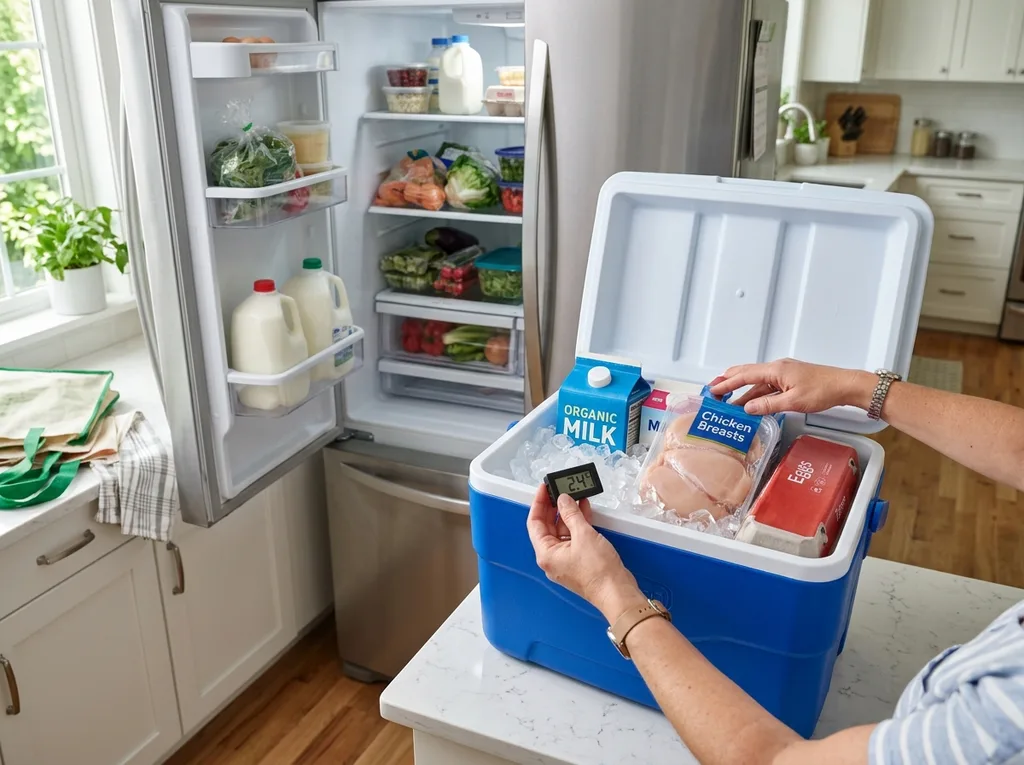
Protect your food before you look for the cause. A warm fridge can spoil food faster than you think.
- Keep the door closed. The USDA’s food safety guidance on FoodSafety.gov says a refrigerator keeps food safe for about 4 hours if the door stays shut. A full freezer holds its temperature for about 48 hours. A half-full freezer holds for about 24 hours.
- Move key items to a cooler with ice. Start with raw meat, poultry, fish, milk, eggs, soft cheese, and leftovers.
- Use a thermometer. The safe zone is 40°F or below for the fridge and 0°F for the freezer, according to FoodSafety.gov’s cold storage chart.
- Throw out risky food. If perishable food has been above 40°F for more than 2 hours, do not keep it.
- Never taste food to test it. Germs that cause food poisoning often cannot be seen, smelled, or tasted.
Why Is the Light On if the Fridge Is Not Cooling?
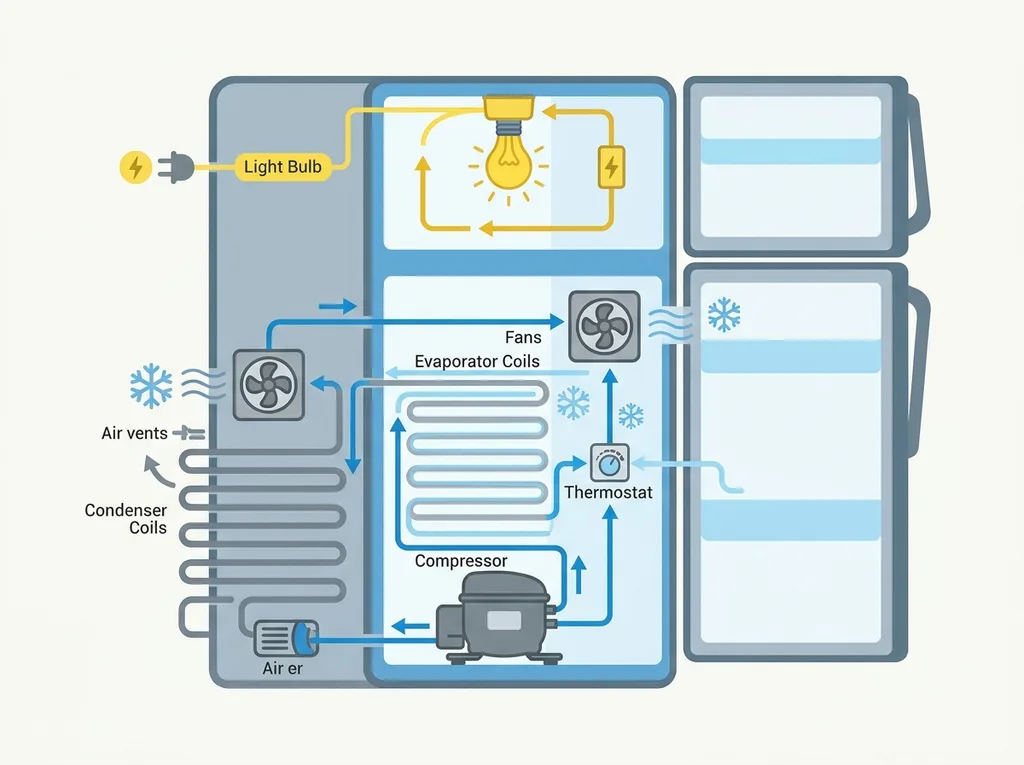
The light and the cooling system work separately. The light is a simple bulb and door switch. Cooling needs several parts working together: the compressor, the condenser coils, two fans, a thermostat, a defrost system, and a control board.
Any one of those parts can fail while the light keeps working. That is also why you can skip checking the outlet. If the light comes on, power is reaching the fridge.
30-Second Symptom Guide
Use this table to narrow down the cause before you start.
| What you notice | Likely cause |
|---|---|
| Freezer is cold, but the fridge is warm | Evaporator fan, blocked vent, or frost buildup |
| Fridge and freezer are both warm, and it is silent | Thermostat, control board, or start relay |
| Clicking sound every few minutes | Start relay or compressor problem |
| Fridge runs all the time but stays warm | Dirty coils, condenser fan, or low refrigerant |
| Fridge got warm after a power outage or storm | Control board or relay hit by a surge |
| Warm air near the door edges | Worn door seal |
Easy Checks First (Causes 1 to 4)
Start here. These four causes are the simplest to find and fix.
1. The Temperature Setting Is Wrong
Someone may have bumped the dial or touched the control panel. Some models also have a “demo” or “off” mode.
What to do: Set the fridge to about 37°F and the freezer to about 0°F. Wait 24 hours before you decide if it worked. A fridge needs time to cool down.
2. Air Vents Are Blocked
In most fridges, cold air starts in the freezer and flows into the fridge through small vents. If food boxes cover those vents, the cold air cannot get through. The freezer stays cold, but the fridge gets warm.
What to do: Move food away from the vents inside the fridge and freezer. Leave a little space around them. Do not pack the shelves tightly.
3. The Condenser Coils Are Dirty
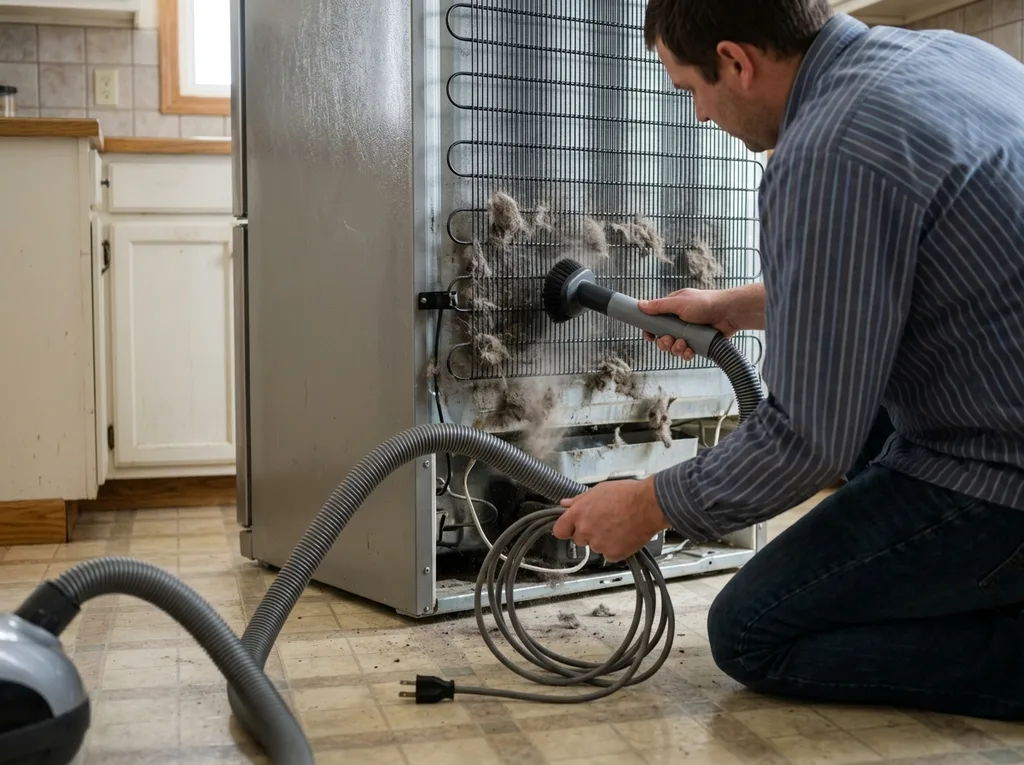
The condenser coils release heat from the fridge. Dust and pet hair act like a blanket on them. The heat gets trapped, and the fridge struggles to cool.
What to do:
- Unplug the fridge.
- Find the coils. They are usually behind the bottom grille or on the back.
- Use a vacuum with a brush attachment to clean them.
- Plug the fridge back in and wait 24 hours.
Clean the coils at least once a year. Do it twice a year if you have shedding pets.
4. The Door Seal Is Worn
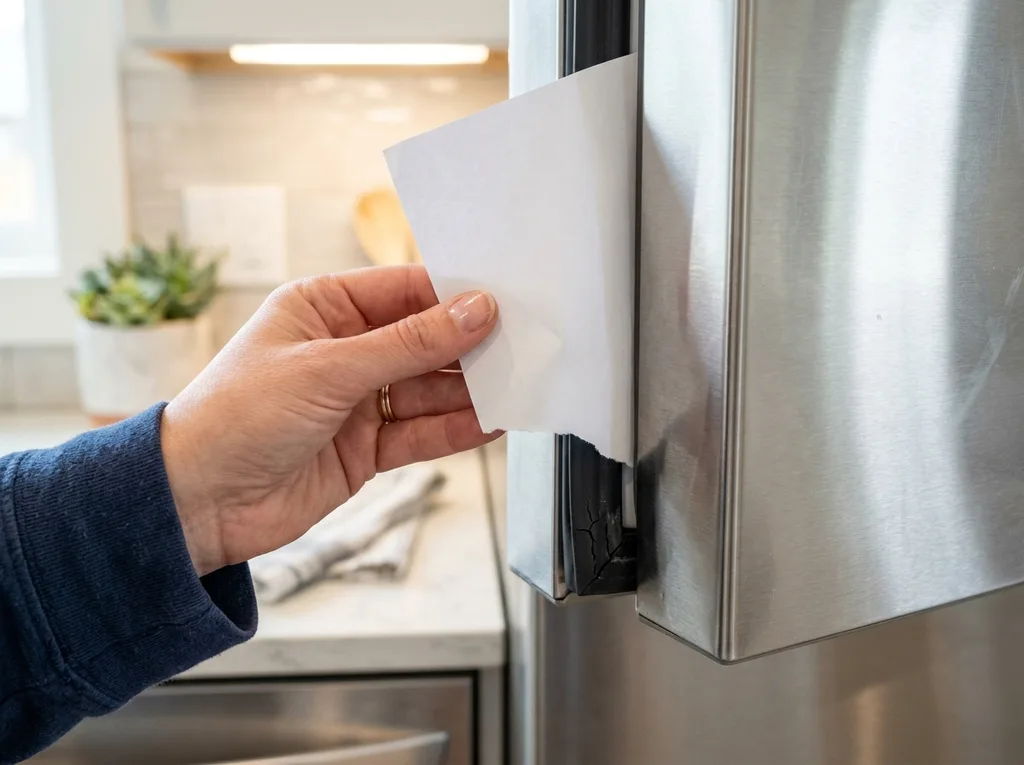
The rubber seal around the door keeps cold air in. If it is cracked or loose, warm air leaks in all day, and the fridge cannot keep up.
Try the paper test: Close the door on a piece of paper. If the paper slides out with no pull, the seal may be weak. Test a few spots around the door. Look for cracks, tears, or moisture along the edge too.
Airflow Problems (Causes 5 to 7)
If the easy checks did not help, look at airflow. A fridge cools by moving cold air, and fans do that job.
5. The Condenser Fan Is Not Running
This fan sits near the compressor at the bottom back of the fridge. It pulls air across the coils to carry heat away. When it stops, the compressor can overheat, and the fridge runs warm.
What to do: Unplug the fridge and check for pet hair or dust jammed around the blades. If the fan spins freely by hand but does not run with power, or if it makes a loud grinding sound, the motor may need to be replaced.
6. The Evaporator Fan Has Failed
This fan sits behind a panel in the freezer. It pushes cold air from the freezer into the fridge. When it fails, the freezer may stay cold while the fridge slowly warms up.
What to check: Open the freezer door and listen. You should hear a soft fan sound. Press the door switch if your model has one. A loud chirp or grinding noise means the motor may be failing. No sound at all can mean the fan is dead or blocked by ice.
7. Frost Has Built Up or the Defrost System Failed
Many fridges melt frost on their own with a defrost heater, a timer, and a sensor. If one of these parts fails, ice builds up on the evaporator coils and blocks the airflow. The fridge then runs but does not cool well.
What to do: If you see a thick sheet of frost on the back wall of the freezer, unplug the fridge for at least 24 hours with the doors open. Put towels on the floor. Do not chip ice with a knife or sharp tool, because you can puncture a coil. If the frost comes back within days, the defrost system needs a technician.
Electrical and Cooling System Problems (Causes 8 to 10)
These problems are harder to test at home. They usually need a technician with the right tools.
8. The Start Relay Is Bad
The start relay gives the compressor a quick boost to get it running. When the relay fails, the compressor cannot start. You may hear a click from the back of the fridge every few minutes. Then the fridge slowly warms up.
A relay is often one of the cheaper parts to replace. However, a technician should confirm the problem first. A repeated start attempt can harm the compressor.
9. The Thermostat or Control Board Is Faulty
The thermostat or control board tells the compressor when to run. If it fails, the fridge may be completely silent while the light stays on. A power surge or storm can also damage a control board.
This is hard to test safely at home. A technician can check the part and tell you if it needs to be replaced.
10. The Compressor Is Failing or Refrigerant Is Leaking
The compressor is the pump of the cooling system. It moves refrigerant, the fluid that carries heat out of the fridge. If the compressor fails, or if refrigerant leaks out, the fridge cannot cool.
Signs include a compressor that runs nonstop, feels very hot, or makes loud noises. You may also notice a faint hissing sound or an oily spot near the tubing.
This is not a DIY job. Working on the sealed system takes special tools and a certified technician. Do not use “stop leak” products you find online. They can damage the system for good.
What to Try, in Order
Follow these steps from easiest to hardest. Stop when your fridge starts cooling.
- Keep the door closed and protect your food (see above).
- Check the temperature setting and look for any error code. Write the code down.
- Clear food away from the vents.
- Unplug the fridge for 5 minutes, then plug it back in.
- Clean the condenser coils.
- Do the paper test on the door seal.
- Listen for the fans (condenser and evaporator).
- Look for frost on the freezer wall.
- Wait 24 hours after any fix to see if it works.
If the fridge is still warm after a full day, the problem is likely the start relay, thermostat, board, or compressor. That is when you should call a technician.
What Not to Do
- Do not bypass parts or tamper with wires. Electric shock and fire are real risks.
- Do not use stop-leak products. They can ruin the compressor.
- Do not open the sealed cooling system. Only a certified pro should do this.
- Do not chip ice with a sharp tool. Let it melt on its own.
- Do not keep resetting the fridge again and again. A reset cannot fix a broken part.
- Do not open the door over and over. Each time you do, you lose cold air.
- Do not open the fridge if you smell a chemical odor. Open a window and call a pro.
How to Reset a Refrigerator That Is Not Cooling
A reset can clear small glitches in the control board. To do it:
- Unplug the fridge, or switch off its breaker.
- Wait 5 minutes.
- Plug it back in or turn the breaker on.
- Keep the door closed.
After the reset, give the fridge time. It can take up to 24 hours to get back to a safe 40°F, especially if it was very warm or very full. If it is still warm after a full day, a part is likely broken.
Refrigerator Not Cooling but the Freezer Works?
If the freezer is cold and the fridge side is warm, cold air is not reaching the fridge. The cooling system itself is working. The usual causes are a failed evaporator fan, blocked vents, or frost on the evaporator coils.
Check the vents first. Then check for frost and listen for the evaporator fan. If you are not sure, a technician can find the problem quickly. For a deeper look at the general problem, you can also read our guide on why your refrigerator is not cooling.
Special Cases in Dallas Homes
After a storm or power outage. A power surge can damage a control board or a start relay. Give the fridge up to 24 hours to recover after the power returns. If it is still warm, call for service.
Fridges in a hot garage. Texas summers are hot. Many refrigerators are built for normal room temperatures. A hot garage can push a fridge past that limit, and it may struggle to keep cool. Check your owner’s manual for the allowed room temperature range.
Mini fridges. A mini fridge with the light on but no cooling often has a bad thermostat or start relay. Make sure it has a few inches of space around it for airflow. If the compressor never hums, a replacement may cost less than a repair.
Samsung and LG models. Many newer Samsung and LG fridges use inverter compressors. These can fail differently than older ones, and some show an error code. Write down any code you see before you call. It helps the technician bring the right part.
How Much Does Refrigerator Repair Cost, and Should You Repair or Replace?
The cost depends on which part failed. Cheap fixes can cost little or nothing. Big parts cost more.
| Fix | Relative cost | DIY or pro? |
|---|---|---|
| Change temperature setting | Free | DIY |
| Clear vents | Free | DIY |
| Clean condenser coils | Low | DIY |
| Replace a door seal | Low to medium | DIY or pro |
| Replace a fan motor | Medium | Pro recommended |
| Replace a start relay | Low to medium | Pro recommended |
| Replace a thermostat or defrost part | Medium | Pro |
| Replace a control board | Medium to high | Pro |
| Replace a compressor or fix a sealed-system leak | High | Pro only |
Repair or replace? A simple rule many people use: if the repair costs more than half the price of a new fridge, and your fridge is already old, replacing it may be smarter. Many fridges last roughly 10 to 15 years. If yours is under 8 to 10 years old and in good shape, a repair like a compressor or start relay is often worth it. If you decide to replace, our team can help with appliance installation too.
When to Call a Dallas Refrigerator Technician
Call a professional if:
- The fridge is still warm after 24 hours
- You hear clicking, humming, or grinding from the back
- The compressor feels very hot
- You smell a chemical odor or hear hissing
- The fridge trips your breaker
- You found thick frost that keeps returning
- You think it is the compressor, the control board, or the sealed system
- You are not comfortable working near the electrical parts
Opening a fridge’s panels can also affect your warranty, so check your warranty first if your fridge is fairly new.
Appliance Repair Rescue is a veteran-owned company serving Dallas, Texas and nearby cities. Here is what you can expect:
- Same-day scheduling, 8 AM to 9 PM, 7 days a week
- Technicians certified through SkillCat
- A clear, flat-rate quote before any work begins
- A 90-day warranty on repairs
- Repairs for major brands, including Samsung, LG, Whirlpool, GE, Maytag, KitchenAid, Frigidaire, Bosch, Kenmore, and luxury brands like Sub-Zero
Recently, a homeowner in Plano, Texas, contacted us because their refrigerator was not cooling even though the interior light was still on. Our technician diagnosed and repaired the issue within one hour, helping restore the refrigerator’s cooling performance.
Learn more about our refrigerator repair service, or see all areas we serve. We provide local service in cities like Garland, Plano, Irving, Mesquite, Richardson, and Carrollton.
Ready for help? Call (972) 370-8353 or book a service request.
How to Prevent Cooling Problems
A few simple habits can help your fridge last longer:
- Vacuum the condenser coils once or twice a year.
- Do not overpack the fridge. Air needs room to move.
- Check the door seals every month.
- Leave a few inches of space behind and above the fridge.
- Keep a thermometer inside. The fridge should stay at 40°F or below.
- Keep the fridge out of direct heat and sun.
- Use a surge protector made for large appliances if power surges are a problem in your area.
Frequently Asked Questions
Why is my refrigerator not cooling but the light is on?
The light and the cooling system run separately. The light can work while a part in the cooling system fails. Common causes are dirty coils, a bad fan, blocked vents, frost buildup, a bad start relay, a faulty thermostat or board, or a failing compressor.
Why is my refrigerator not cooling but the freezer works?
Cold air is not reaching the fridge section. The usual causes are a failed evaporator fan, blocked vents, or frost on the evaporator coils. Check the vents and look for frost first.
Can a bad compressor leave the light on?
Yes. The light does not depend on the compressor. A failed compressor or start relay can leave the light on while the fridge slowly warms up. Clicking sounds or a very hot compressor are warning signs.
How long does a refrigerator take to cool down after a reset?
It can take up to 24 hours to return to a safe 40°F. Keep the door closed during that time. If it is still warm after a full day, a part is likely broken.
Can a power surge stop a refrigerator from cooling?
Yes. A surge can damage the control board or the start relay. If your fridge stopped cooling after a storm or outage, wait up to 24 hours. If it is still warm, call a technician.
Is my food safe in a fridge that is not cooling?
Food stays safe for about 4 hours if the door stays closed, according to FoodSafety.gov. After that, perishable food above 40°F for more than 2 hours should be thrown out. When in doubt, throw it out.
Is it worth repairing a refrigerator that is not cooling?
Often yes, especially for simple fixes like coils, seals, fans, and relays. If your fridge is old and needs a compressor or a sealed-system repair, replacing it may be the better value.
Why does my refrigerator stop cooling in hot weather?
Heat makes the fridge work harder. Dirty coils, a weak fan, a hot garage, or a loose door seal can show up more in summer. Clean the coils, check the seal, and give the fridge room to breathe.
Final Thoughts
When your refrigerator is not cooling but the light is on, the problem is in the cooling system, not the power. Start with the easy checks: the temperature setting, vents, coils, and door seal. Protect your food right away, and give each fix about 24 hours to work.
If the fridge is still warm, or if you hear clicking, hissing, or grinding, do not guess. Call a pro. Appliance Repair Rescue is ready 24/7 with a clear quote and a 90-day warranty. Call (972) 370-8353 or visit our refrigerator repair page to get started.
Sources
- FoodSafety.gov (USDA): Food Safety During a Power Outage
- FoodSafety.gov (USDA): Cold Food Storage Chart