
You open the lid or the door, and the drum is still full of dirty water. Your clothes are soaked. Your laundry day just got a lot harder.
If you are asking, Why is my washer not draining? take a breath. This is one of the most common washer problems, and the cause is often simple. Many people fix it in less than 30 minutes with a towel, a bucket, and a little patience.
In this guide, you will learn the most common reasons a washer will not drain. You will also learn how to check each one safely, what the error codes mean, what repairs usually cost, and when to call a professional.
Quick Answer: Why Is My Washer Not Draining?
Most of the time, a washer will not drain for one of these reasons:
- A clogged drain pump filter (common in front-load washers)
- A kinked or blocked drain hose
- A clogged drain line in your home
- A broken drain pump
- A bad lid switch (top-load) or door lock (front-load)
- Too much detergent, an unbalanced load, or the wrong cycle
- A control board problem (less common)
Start with the easy checks first: the hose, the filter, and your settings. If those look fine, the problem is probably a part that needs a technician.
Stay Safe Before You Touch Anything
Water and electricity do not mix. Before you start any fix, follow these steps:
- Unplug the washer. Do not just turn it off. Pull the plug from the wall.
- Put towels on the floor. More water will come out than you expect.
- Keep a shallow pan and a bucket nearby. A baking pan works well.
- Wear gloves. Filters can hide sharp things like bra wires, pins, and glass.
- Never reach into the pump with your bare hand. Use a flashlight to look first.
If water is leaking near the plug or you see sparks, stop. Call a pro.
How a Washer Drains (In Plain English)
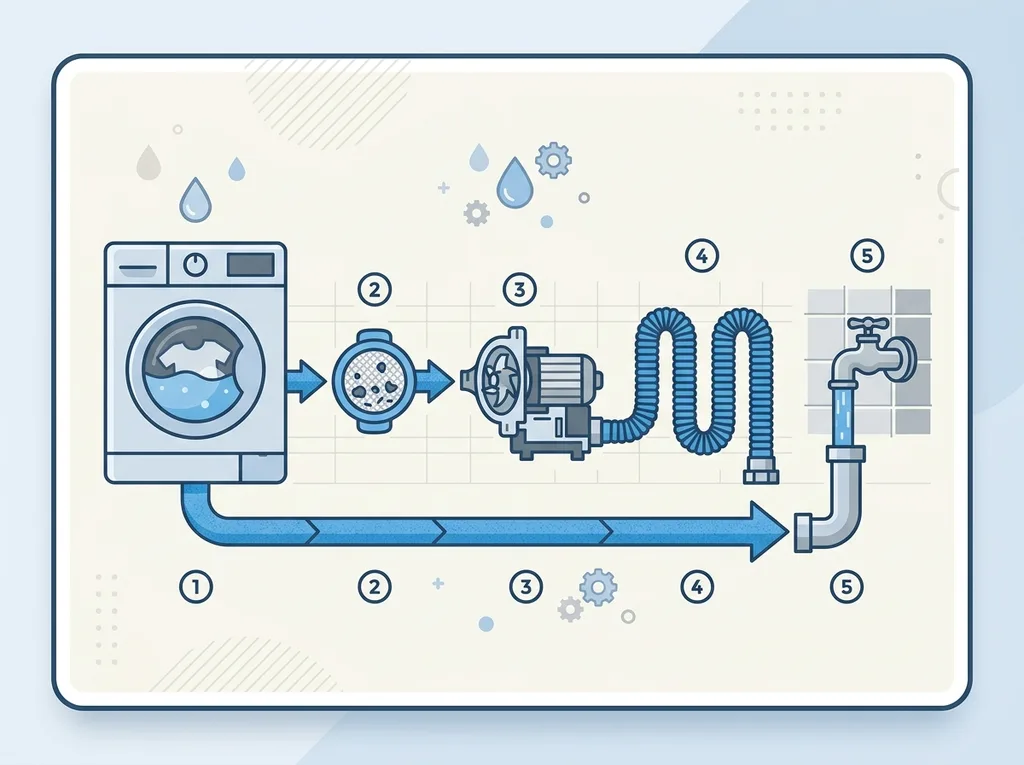
Your washer has a small pump. After the wash and rinse steps, the pump pushes dirty water out of the tub. The water travels through a drain hose and into a standpipe or a laundry sink drain.
A small filter often sits in front of the pump. It catches lint, coins, and other small items so they do not damage the pump.
A problem anywhere on this path can stop the water. It can be the filter, the hose, the pump, the drain in your wall, or even the part that tells the washer it is safe to run. That is why we check the easy parts first.
Quick Symptom Guide
Use this table to guess where the problem may be.
| What you notice | Likely cause |
|---|---|
| Water stays in the drum and the washer is silent | Lid switch, door lock, or control board |
| You hear humming, but no water leaves | Clogged or weak drain pump |
| You hear grinding or rattling | Something stuck in the pump |
| Water drains very slowly | Kinked hose, partial clog, or too many suds |
| An error code shows on the screen | See the error code section below |
| Your sink or toilet also drains slowly | Clogged drain line in your home |
9 Common Reasons Your Washer Is Not Draining
1. A Clogged Drain Pump Filter
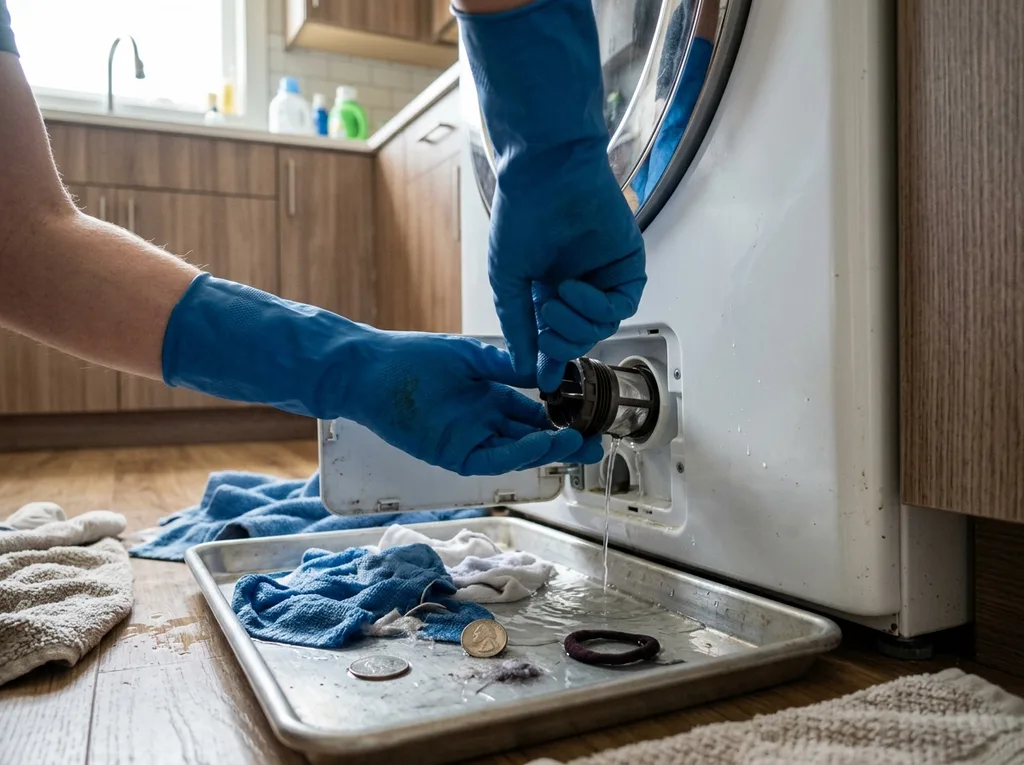
This is the number one cause in front-load washers. Coins, hair ties, socks, buttons, and lint collect in the filter and block the water.
How to check it:
- Unplug the washer.
- Find the small access panel at the bottom front of the washer.
- Place towels and a shallow pan under it.
- Slowly turn the filter cap to the left. Let the water run out.
- Pull out the filter and remove any junk.
- Look into the filter opening with a flashlight for items that slipped past.
- Put the filter back in tightly. A loose filter can leak.
Many top-load washers do not have a filter you can reach. Some newer models do not have one at all. Check your owner’s manual for your model.
2. A Kinked or Clogged Drain Hose
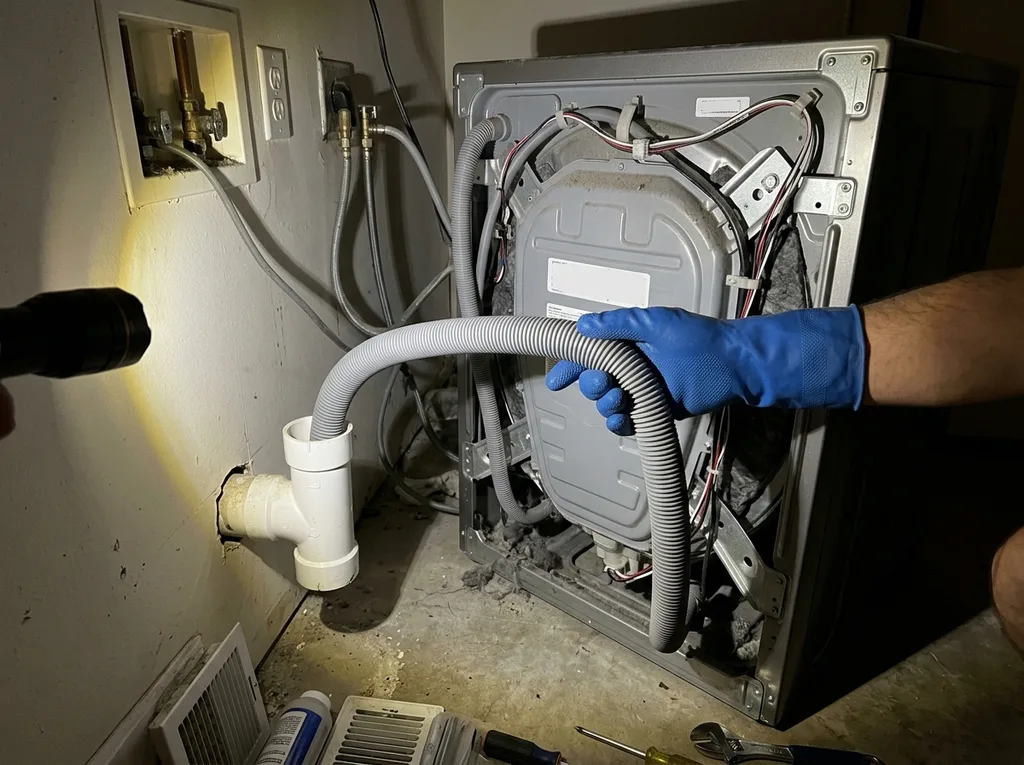
The drain hose runs from the back of your washer to the drain. If you pushed the washer against the wall, the hose may be bent. Lint and soap buildup can also block it over time.
How to check it:
- Pull the washer forward a little.
- Look for sharp bends or flat spots in the hose.
- Straighten the hose and run a drain and spin cycle.
- If the water still does not move, drain the tub first. Then disconnect the hose, hold it over a bucket, and look through it for clogs such as socks or lint.
3. The Hose Is in the Wrong Spot
Even a clear hose can cause trouble if it is set up the wrong way. Water may drain slowly, or it may flow back into the washer.
Check these things:
- Depth in the standpipe. Don’t push the hose too far down into the pipe. A common guide is about 6 to 8 inches. If it goes too deep, it can cause a siphon problem.
- Height. Every washer has a height range for the drain hose. If the hose is too low or too high, the pump may struggle. Check your manual for the right range.
- Air gap. The hose should not be sealed tightly into the pipe. Air needs to get in so the water can flow.
4. A Clogged Drain Line in Your Home
Sometimes the washer is fine, and the clog is in the wall. This often happens when soap, lint, and hair build up inside the pipe.
Here is a quick test. Run water in a nearby sink and flush a toilet. If they drain slowly too, your home drain may be blocked. In that case, you may need a plumber instead of a washer technician.
5. A Broken Drain Pump
The drain pump is the part that pushes the water out. It can burn out with age. A small object can also jam the little fan inside it, called the impeller.
Signs of a bad pump include:
- A humming sound, but no water leaves the tub
- Grinding or rattling during the drain cycle
- A leak under the washer
- Water drains only a little, then stops
If the filter and hose are clear and you still hear these signs, the pump likely needs to be replaced. This is a job for a technician. Keep running cycles only if you must, because a struggling pump can burn out fully.
6. A Bad Lid Switch or Door Lock
Washers have a safety feature. They will not drain or spin unless the lid or door is closed and locked. If the switch or lock breaks, the washer thinks the lid is open and stops.
Top-load washers: Close the lid firmly. Then press the lid switch with your finger or a pencil while the washer is unplugged and the cycle is set up to drain. Listen for a click. If there is no click, the switch may be worn out.
Front-load washers: Listen for a clunk when you start a cycle. If you do not hear the door lock engage, or the door will not open at all, the lock may have failed.
7. Too Much Detergent
Too many suds can confuse your washer. The sensors may think the tub is still full, so the washer slows down or stops draining.
If you see a lot of foam, try this:
- Run a rinse or a drain and spin cycle.
- Next time, use less soap. Most loads need less than you think.
- Use HE (high-efficiency) detergent if your washer is an HE model.
8. An Unbalanced Load or the Wrong Cycle
When clothes bunch up on one side, the washer may slow down or stop the spin. A single heavy item, such as a blanket or a rug, can cause this.
Some cycles also spin slowly on purpose. Delicate and Hand Wash cycles often leave more water in the tub. If you chose a low-spin or no-spin option, the water may not leave the way you expect.
Easy fix: Open the lid or door, spread the clothes out, and add a few items if the load is too small. Then choose Drain and Spin.
9. A Control Board Problem
The control board is the washer’s brain. It tells the pump when to start and stop. If the board fails, the washer may fill and wash but never drain.
This is less common than the other causes. A power surge can sometimes damage it. A board problem is hard to test at home, so if you have checked everything else, call a technician.
Error Codes That Point to a Drain Problem
Many washers show a code when they cannot drain. Codes are different for each brand, so always check your manual too. Here are some common ones:
| Brand | Common drain code | What it often means |
|---|---|---|
| Whirlpool / Maytag | F21 or F9 E1 | Long drain, water not leaving fast enough |
| LG | OE | Drain error |
| Samsung | 5E or SE | Drain error |
| Electrolux / Frigidaire | E21 | Drain problem |
Write down the code before you unplug the washer. It helps a technician find the problem faster.
How to Drain a Washer Full of Water by Hand
You may need to get the water out before you can fix the problem or rescue your clothes.
Front-load washer:
- Unplug the washer.
- Open the filter access panel.
- Many models have a small emergency drain hose. Pull it out, uncap it, and let the water flow into a pan.
- If there is no hose, slowly loosen the filter cap and let the water out a little at a time. Empty the pan often.
Top-load washer:
- Unplug the washer.
- Pull the washer forward and disconnect the drain hose from the wall.
- Lower the end of the hose into a bucket on the floor. Gravity will pull the water out.
- Raise the hose end when the bucket is nearly full, and empty it. Repeat.
If your washer is leaking or you are not sure what you are doing, do not force it. Call a professional.
A Simple 10-Minute Checklist
Try these steps in order:
- Close the lid or door firmly and run Drain and Spin.
- Check for an error code and write it down.
- Redistribute the load and cut back on detergent.
- Unplug the washer for a full minute, plug it back in, and restart. Some models reset this way.
- Make sure the washer plugs straight into the wall, not into a power strip.
- Check the drain hose for kinks.
- Clean the pump filter (front-load).
- Test your sink and toilet for slow drains.
If nothing works, the problem is probably the pump, the lid switch, the door lock, or the control board.
What Not to Do
- Do not keep running cycles. This can overheat or burn out the pump.
- Do not pour harsh drain cleaner into the washer. It can harm rubber parts and is not safe for your skin or eyes.
- Do not open the cabinet with the washer plugged in.
- Do not ignore standing water. Water that sits in the drum can start to smell and grow mold.
- Do not force a stuck door. You can break the latch.
How Much Does It Cost to Fix a Washer That Won’t Drain?
The price depends on the cause. Cleaning a filter or fixing a kinked hose can cost little or nothing. A new drain pump, lid switch, or control board costs more because of the part and the labor.
In many cases, washer repairs land in the range of about $100 to $400. Your exact price depends on your washer brand, the part, and how hard it is to reach.
Repair or replace? Most washers last about 10 to 13 years. A simple rule many people use: if the repair costs more than half the price of a new washer, and your washer is already old, replacing it may be smarter. If the washer is fairly new, repair is usually the better choice.
A good technician will tell you the cost before the work starts, so you can decide.
When to Call a Professional
Call a pro if:
- The filter and hose are clear, but the water still will not drain
- You hear humming or grinding from the pump
- The washer leaks while you work on it
- The door is locked and you cannot get it open
- You see an error code that keeps returning
- You smell burning
- You are not comfortable working on the machine
Trying to fix electrical parts without training can be risky. A technician has the tools to test the pump, switch, and board the right way.
How to Keep Your Washer Draining Well
A few habits can prevent most drain problems:
- Check pockets. Coins, pens, tissues, and hair ties cause many clogs.
- Use mesh bags for small items. Socks and bras are the usual troublemakers.
- Use the right amount of detergent. More soap does not mean cleaner clothes.
- Clean the pump filter every few months (front-load washers).
- Leave space behind the washer so the drain hose does not bend.
- Do not overload the drum.
- Run a washer cleaning cycle once a month to clear soap and lint buildup.
- Keep the door or lid slightly open after the wash so the drum can dry.
Washer Repair in Dallas, TX
If you have tried the steps above and are still asking, “Why is my washer not draining?” our team at Appliance Repair Rescue can help. We repair washers in Dallas and nearby areas, including Plano, Irving, Garland, Richardson, Mesquite, Frisco, and Carrollton.
We work on top-load and front-load washers from major brands, including Whirlpool, Samsung, LG, GE, Maytag, and Kenmore. We explain the problem in plain words and give you a clear quote before any repair starts.
Learn more about our washer repair service in Dallas, or call (972) 370-8353 to ask about same-day availability.
Frequently Asked Questions
Why is my washer full of water and not draining?
The most common causes are a clogged pump filter, a kinked drain hose, or a failed drain pump. A bad lid switch, a bad door lock, or too much detergent can also stop the washer from draining.
Why won’t my washer drain or spin?
When a washer will not drain and will not spin, the lid switch or door lock is often the cause. A clogged pump or a control board issue can also do this. Check that the lid or door closes firmly, then check the filter and hose.
How long should a washer take to drain?
Most washers drain in about one to two minutes per drain step. If water is still in the tub after the cycle ends, or if it takes much longer than normal, something is slowing it down.
Can too much detergent stop a washer from draining?
Yes. Too many suds can confuse the sensors and slow down the pump. Use less detergent and choose HE detergent if you have an HE washer.
Is it safe to leave water sitting in my washer?
It is not a good idea to leave it for long. Standing water can cause a bad smell and mold. It can also keep your clothes wet and sour. Drain the water and fix the problem as soon as you can.
Can I fix a washer that will not drain myself?
Often, yes. Cleaning the filter, straightening the hose, and adjusting the load are safe fixes for most people. If the problem is the pump, the switch, or the control board, it is best to call a professional.
Final Thoughts
A washer that will not drain is stressful, but the fix is often easy. Start with the simple checks: the load, the soap, the hose, and the filter. If the problem is deeper, a trained technician can find it quickly and get your laundry back on track.
Still stuck? Call (972) 370-8353 or visit our Dallas washer repair page to schedule service.